
Karma Siddhant — How Past Connections Influence Present Life
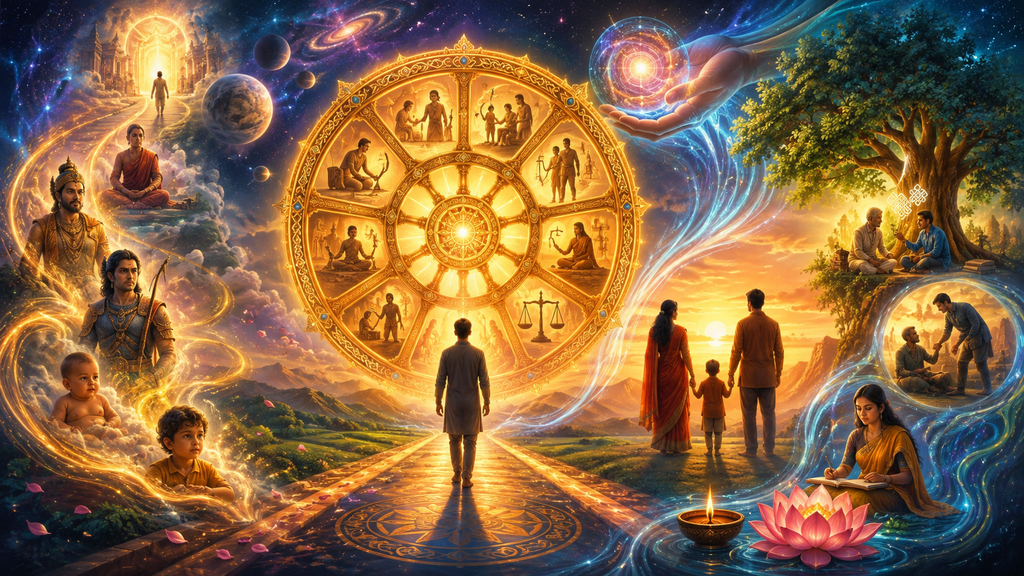
Human life does not begin only with birth. According to the traditional concept of Karma Siddhant, every birth is part of a much longer journey. We enter this life carrying impressions, unfinished responsibilities, relationships, and karmic tendencies from earlier births. Our present life gives us another opportunity to experience, understand, complete, and transform some of those karmic patterns.
One of the most interesting aspects of Karma Siddhant is the relationship between parents and children. From a spiritual point of view, it is often said that children come into a particular family because there is some karmic connection to be completed. In this understanding, parents do not simply “select” their children; the soul is believed to take birth in an environment where certain experiences, duties, and relationships can unfold. The same principle may apply to husband and wife, brothers and sisters, mothers and daughters, fathers and sons, and many other close relationships.
Sometimes, people within the same family share a deep natural affection. They understand one another easily, support each other, and remain emotionally connected even during difficult periods. From the perspective of Karma Siddhant, this may reflect a harmonious connection carried from some earlier birth. Such relationships may return so that unfinished good karma, affection, responsibility, or mutual support can continue and be completed.
The opposite can also happen. A mother and son, father and daughter, husband and wife, or even two siblings may live very close to one another but still find it difficult to connect emotionally. There may be repeated misunderstandings, distance, conflict, or a feeling that they simply do not understand one another. At the same time, a person may unexpectedly feel very close to someone outside the family whom they have known only for a short time. Traditional karmic philosophy explains such experiences through connections carried from previous births.
These previous connections should not be understood as belonging only to the immediately preceding birth. The philosophy of rebirth speaks of many births. A soul may have experienced different kinds of relationships in different lives. Someone who is a family member in the present life may have shared a completely different relationship with us in another birth. Therefore, certain people may come together again in the present life to complete unfinished duties, repay obligations, experience affection, resolve conflict, or learn an important lesson.
This is where concepts such as Runa, Roga, and Shatru become important. Runa represents debts, obligations, or responsibilities that may need to be fulfilled. Roga may be understood as suffering or difficulties through which certain karmic lessons are experienced. Shatru can represent opposition, conflict, competition, or difficult relationships that repeatedly challenge us. These should not be interpreted with fear. Rather, they can be understood as areas in which life is asking us to develop greater awareness, responsibility, patience, and wisdom.
However, Karma Siddhant does not mean that everything is fixed and that we are helpless. This is a very important point. A person should never think, “My karma is bad, therefore I cannot do anything.” The present birth also gives us the power to create new karma through our thoughts, decisions, actions, discipline, service, kindness, and conduct. This is the role of free will.
We may not be able to change every circumstance that comes to us, but we can choose how we respond to it. Good actions performed in the present life create new positive impressions and may influence our future experiences. In the same way, careless or harmful actions may create new karmic responsibilities. Therefore, present-life effort is extremely important.
Karma Siddhant should ultimately encourage us to live more consciously, not more fearfully. Instead of blaming destiny, family members, circumstances, or past karma, we can ask ourselves: What is this situation teaching me? What responsibility do I have here? What can I do better now?
The purpose of understanding karma is not to become passive. It is to recognize that life may bring us certain situations because of deeper connections, while at the same time giving us the freedom to respond with wisdom. By choosing better actions in the present, we can gradually transform the direction of our life and create better karma for the future.